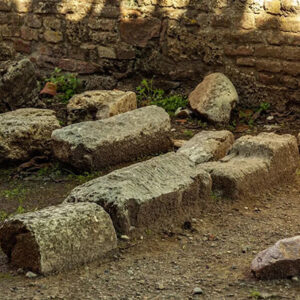
The origins of Stonehenge’s massive Altar Stone have been the subject of speculation and research for years.
New evidence suggests that this 6-ton sandstone slab, central to the world-famous monument, did not originate from Wales as previously believed, but instead from northeast Scotland, some 460 miles away. While the exact method of its transportation remains a mystery, the findings hint at surprisingly advanced technology and organization in Neolithic Britain.
Previous geological studies had suggested that the Altar Stone came from the Brecon Beacons in southeast Wales. The Brecon Beacons, located about 50 miles from the Stonehenge site on Salisbury Plain, were thought to be the source of this iconic stone.
However, a new study, led by Australian researchers, has upended this assumption and revealed a much farther origin—Scotland. This discovery drastically changes our understanding of Stonehenge’s construction and raises intriguing questions about the people who built it.
The research team from Curtin University in Perth, Australia, utilized advanced equipment, including mass spectrometers, to study the composition of the Altar Stone. Their findings, published in the scientific journal Nature, have revealed a striking geological fingerprint that links the Altar Stone to a region in northeast Scotland, specifically the Orcadian Basin.
Study lead author Anthony Clarke explained, “Our analysis found specific mineral grains in the Altar Stone are mostly between 1,000 to 2,000 million years old, while other minerals are around 450 million years old. This provides a distinct chemical fingerprint suggesting the stone came from rocks in the Orcadian Basin, Scotland, at least 750 kilometers away from Stonehenge.”
These results clearly differentiate the Altar Stone from the bedrock found in Wales, disproving earlier theories about its origin. The study represents a significant advancement in our understanding of Stonehenge’s construction, especially in terms of the transportation of these colossal stones.
One of the most fascinating aspects of the study is the question it raises about how such a massive stone could have been transported from Scotland to southern England over 5,000 years ago. Given the technological limitations of the Neolithic period, moving a 6-ton stone over hundreds of miles would have been an extraordinary feat.
Professor Chris Kirkland, co-author of the study, pointed to the possibility of a marine shipping route, saying, “Transporting such massive cargo overland from Scotland to southern England would have been extremely challenging, indicating a likely marine shipping route along the coast of Britain. This implies long-distance trade networks and a higher level of societal organization than is widely understood to have existed during the Neolithic period in Britain.”
The suggestion of a sophisticated maritime transport network is particularly intriguing, as it implies that Neolithic people had developed a method for moving large stones across great distances by sea. This challenges long-held assumptions about the capabilities of ancient societies in Britain and offers new insight into the complexity of their social and technological systems.
While this groundbreaking study has confirmed that the Altar Stone originated in Scotland, researchers are still working to pinpoint the exact location within the northeast of Scotland where the stone was quarried.
Co-author Professor Richard Bevins from Aberystwyth University in Wales emphasized that the search is not over: “While we can now say that this iconic rock is Scottish and not Welsh, the hunt will still very much be on to pin down where exactly in the northeast of Scotland the Altar Stone came from.”
The quest to uncover the precise quarry site in Scotland continues, but this new discovery already provides valuable insight into the vast distances and impressive logistical efforts involved in Stonehenge’s construction. It also raises questions about the relationships and trade routes that may have existed between different regions of Britain during the Neolithic period.
For Anthony Clarke, the study holds special meaning, as Stonehenge has played a key role in his personal and academic journey. Clarke, who grew up in the Mynydd Preseli area of Wales—home to some of Stonehenge’s bluestones—felt a deep connection to the monument from a young age.
He shared, “I grew up in the Mynydd Preseli, Wales, where some of Stonehenge’s stones came from. I first visited Stonehenge when I was one year old and now at 25, I returned from Australia to help make this scientific discovery—you could say I’ve come full stone circle.”
This connection between Clarke’s childhood and his scientific work underscores the enduring fascination that Stonehenge holds for both researchers and the public alike. Despite its ancient origins, the monument continues to inspire new generations of scientists who are dedicated to uncovering its secrets.
Despite its global fame, Stonehenge remains a site of frequent and significant discoveries. In 2021, for instance, archaeologists identified evidence of a 110-meter (360-foot) stone circle at Waun Mawn near Mynydd Preseli.
This discovery led to the theory that many of Stonehenge’s bluestones may have been “recycled” from earlier stone circles in the region. These ongoing findings demonstrate that, even after centuries of study, Stonehenge still has much to reveal about its history and construction.
What are your thoughts? Please comment below and share this news!
True Activist / Report a typo